Crazy Train (Ozzy Osbourne) bass tone and bass amp settings
Crazy Train bass tone on a Fender Rumble 40 V3: medium gain (Gain 6), forward high-mids (High Mid 2), balanced lows (Bass 1), neck P pickup.
Tuning: E standard
Settings for your amp
Crazy Train settings on a Fender Rumble 40 V3
Fender Rumble 40 V3 settings for every songAmpFender Rumble 40 V3
BassPassive P/J bass
The same settings in text
Amp
- Gain
- 6
- Bright
- On
- Contour
- Off
- Vintage
- Off
- Overdrive
- Off
- Bass
- +1
- Low Mid
- +1
- High Mid
- +2
- Treble
- +1
- Master
- Set to your room
Passive P/J bass
- Neck Volume (P)
- 10
- Bridge Volume (J)
- 2
- Tone
- 8
A Marshall-style amp would better reproduce the documented tube overdrive and compression.
Crazy Train settings on an Ampeg Rocket Bass RB-108
Ampeg Rocket Bass RB-108 settings for every songAmpAmpeg Rocket Bass RB-108
BassPassive P/J bass
The same settings in text
Amp
- SGT
- Off
- Volume
- Set to your room
- Bass
- +1
- Midrange
- +2
- Treble
- +1
Passive P/J bass
- Neck Volume (P)
- 10
- Bridge Volume (J)
- 3
- Tone
- 8
A Marshall-style tube amp would better match the recorded compression.
Crazy Train settings on any bass amp with Bass, Mid, Treble, Drive
Amp
BassPassive P/J bass
The same settings in text
Amp
- Bass
- 6
- Mid
- 7.5
- Treble
- 5.5
- Drive
- 3.5
Passive P/J bass
- Neck Volume (P)
- 10
- Bridge Volume (J)
- 2.5
- Tone
- 7
A Marshall-style bass amp adds the documented natural overdrive and tube compression.
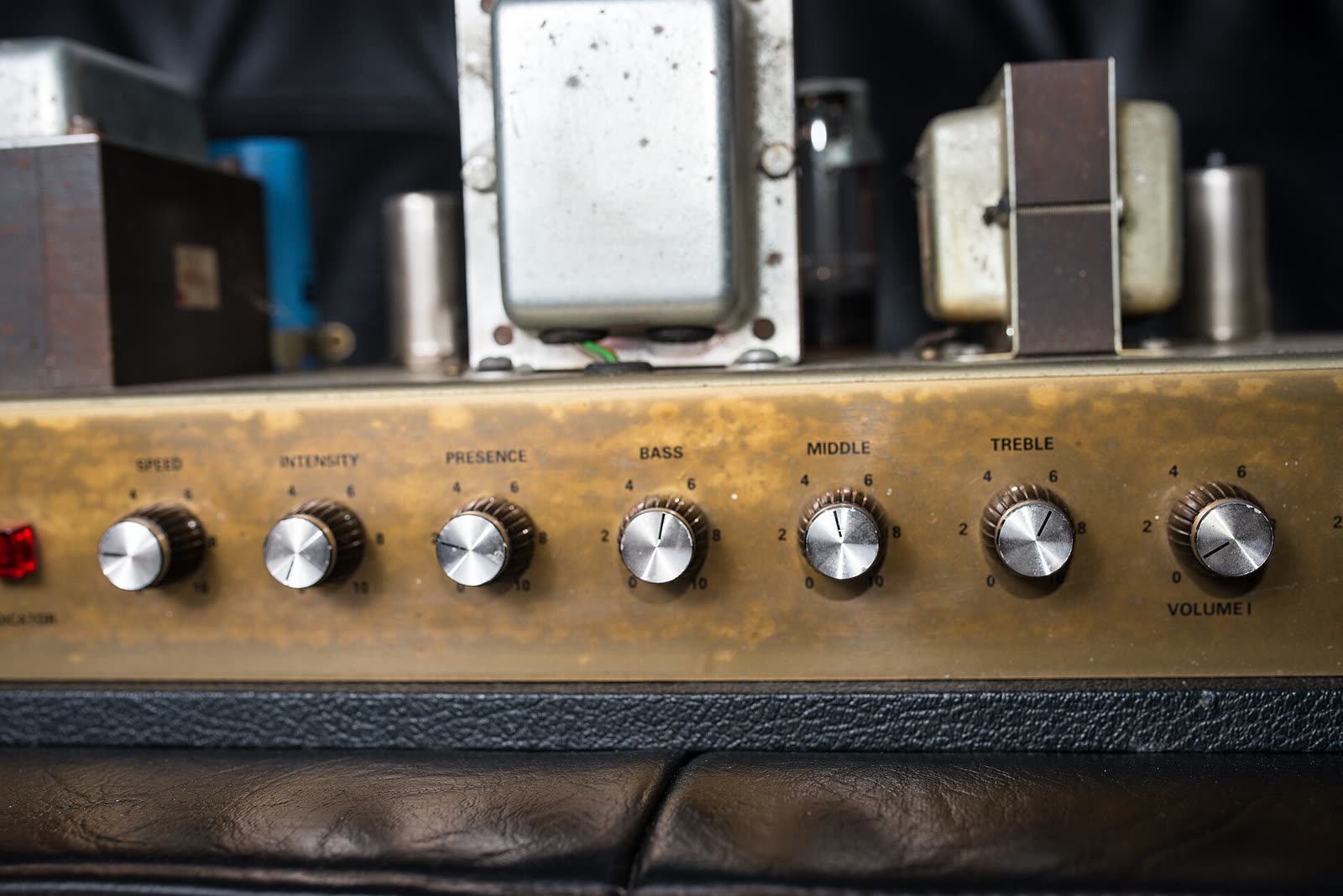
Why it sounds like that
Bob Daisley played a Gibson EB3 bass through one of Randy Rhoads's 100-watt Marshalls on the track. The album sessions used the same bass through a 100-watt Marshall, with the setup miked. The Marshall adds a little natural overdrive and rich tube compression. Daisley is no fan of effects, and none is heard on Crazy Train. The verse is a two-bar pattern of staccato quarter notes that answers the drums, and the chorus pushes forward on anticipated beats.
- Play the recurring intro on root notes only.
- In the verse, play dry staccato quarter notes in bar one, then offbeats in bar two.
What amp did Bob Daisley use on Crazy Train?
- Daisley said the song realised his long-time ambition to co-write and play on a classic composition. (on this song)[1]
- Daisley said he played a Gibson EB3 through one of Randy's 100w Marshalls on Crazy Train. (on this song)[1]
- Bonedo reports Daisley's own account of a Gibson EB-3 through a 100 Watt Marshall with 4x12 cabinets, miked, on the Blizzard of Ozz album. (on the album Blizzard of Ozz)[2]
- Bonedo says Daisley is no fan of effects, and none is heard on Crazy Train. (on this song)[2]
- Bonedo says the Marshall amp brings a little natural overdrive and rich tube compression. (on this song)[2]
- Intro: Bonedo says the intro is built on kicks shared by all the musicians on beats 1 and 1+ and 3 and 3+. (on this song)[2]
- Intro: Bonedo says the recurring intro is limited to the root notes. (on this song)[2]
- Verse: Bonedo says the verse is a two-bar pattern of dry staccato quarter notes in bar one, with an offbeat-dominated second bar. (on this song)[2]
- Verse: Bonedo says the bassline plays a call-and-response with the drums in the verse's second bar. (on this song)[2]
- Verse: Bonedo says a scale motif descending from the octave gives the verse's second bar a nice contrast. (on this song)[2]
- Chorus: Bonedo says the chorus is built on unison kicks, with solid eighth-note rock between them that lifts it above the verse. (on this song)[2]
- Chorus: Bonedo says the chorus has many anticipated beats, mainly the one, that drive it forward. (on this song)[2]
- Solo: Bonedo says Daisley shifts up a gear in the solo with a Riding Horse figure of an eighth note plus two sixteenths. (on this song)[2]
- Louder reports: ‘that signature riff in F-sharp-minor from Crazy Train was Randy’s, then I wrote the part for him to solo over, and Ozzy had the vocal melody.’ (on this song)[3]
Questions
What amp did Bob Daisley use on Crazy Train?
The sources on this page document Bob Daisley's gear on Crazy Train by Ozzy Osbourne: bass, Gibson EB3 [1]; amp, 100w Marshall [1]. Each value cites the numbered source it comes from, listed at the foot of the page.
What are the Crazy Train settings on a Fender Rumble 40 V3?
For the Crazy Train bass tone on a Fender Rumble 40 V3, set Gain 6, Bright On, Bass +1, Low Mid +1, High Mid +2, Treble +1; on the passive P/J bass, Neck Volume (P) 10, Bridge Volume (J) 2, Tone 8. Set Master to your room. They are AI-assisted starting points; adjust them by ear on your own amp.
What are the Crazy Train settings on an Ampeg Rocket Bass RB-108?
For the Crazy Train bass tone on an Ampeg Rocket Bass RB-108, set Bass +1, Midrange +2, Treble +1; on the passive P/J bass, Neck Volume (P) 10, Bridge Volume (J) 3, Tone 8. Set Volume to your room. They are AI-assisted starting points; adjust them by ear on your own amp.
What tuning is Crazy Train in?
Crazy Train by Ozzy Osbourne is played in E standard, according to the cited source [3]. Tune to it before you set the amp, or the riff will not sit right against the record.
Can I get the Crazy Train tone on my own amp?
Yes. The settings above cover 2 reference amps and any amp with the basic controls. For your exact rig, KnobMaster, an iPhone app, sets every knob of your own amp, bass and pedals for Crazy Train, using only the controls your gear has.
Get it for your exact rig
KnobMaster sets every knob of your own amp, bass and pedals for this song.
Download KnobMaster on the App Store